Supreme Night Number Patterns: Do Trends Really Matter?
Explore Supreme Night number patterns and understand whether trends really matter. Learn how charts work, pattern myths, data behavior, and smart ways to analyze Supreme Night results.
The idea of number patterns has always attracted attention in night markets, and the Supreme Night market is no exception. Many users regularly observe Supreme Night charts hoping to identify repeating numbers, sequences, or trends that appear over time. But an important question often arises: Do Supreme Night number patterns really matter, or are they simply coincidental?
This article takes a clear and balanced look at supreme night number patterns. It explains what number patterns are, how people identify trends, why charts are analyzed, and whether trends should be taken seriously. Written especially for beginners, this guide focuses on understanding rather than assumptions.
What Are Supreme Night Number Patterns?
Supreme Night number patterns refer to the observation of recurring numbers, sequences, or behaviors within the Supreme Night chart over a period of time. These patterns are identified by reviewing past results and comparing them with recent outcomes.
Some common examples of observed patterns include:
-
Repeating single numbers
-
Frequently appearing jodi combinations
-
Gaps between certain numbers
-
Sequential number movements
-
Similar number sets appearing weekly or monthly
It is important to understand that these patterns are observations, not confirmed rules.
Why Do People Look for Patterns in Supreme Night Charts?
Humans naturally try to find order in data. When users see charts with months or years of results, it feels logical to search for trends that might explain number behavior.
People analyze Supreme Night number patterns for several reasons:
-
To understand chart history
-
To study how results are recorded
-
To identify frequently appearing numbers
-
To feel more confident while reading charts
-
To learn how numbers behave over time
For beginners, chart analysis often starts with curiosity rather than certainty.
Understanding the Supreme Night Chart Structure
To understand number patterns, you must first understand the chart itself.
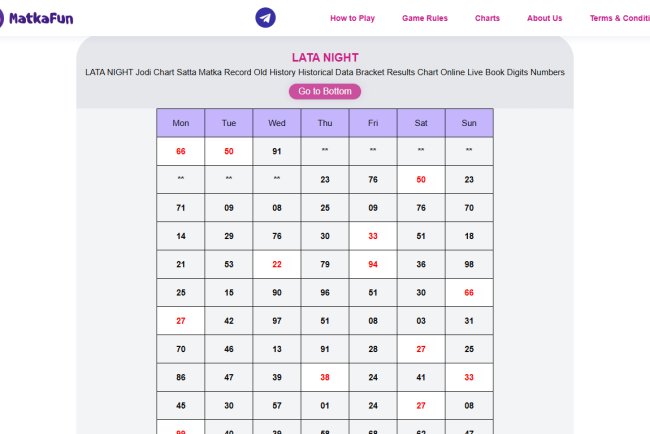
Date-Based Entries
Each row in the supreme night chart represents a specific date on which a result was declared.
Number Display
Numbers may appear as:
-
Single digits
-
Jodi (two-digit numbers)
-
Patti or panel (three-digit combinations)
Continuous Record
Charts show a continuous record of results, making it easy to observe long-term behavior.
Without understanding this structure, pattern analysis can be misleading.
Common Types of Number Patterns Observed
Over time, users have identified certain common types of patterns while reviewing Supreme Night charts.
Repetition Patterns
This is when a specific number appears multiple times within a short time frame.
Gap Patterns
Some users track how long a number has not appeared, assuming it may show up again.
Sequential Patterns
These involve numbers appearing in numerical order, such as 3 followed by 4 or 5.
Frequency Patterns
This focuses on how often certain numbers appear compared to others.
While these patterns may look interesting, they should be viewed cautiously.
Do Trends in Supreme Night Charts Really Matter?
This is the most important question—and the answer requires a balanced understanding.
Charts Show Records, Not Predictions
Supreme Night charts are historical records. They show what has already happened, not what will happen next.
Patterns Are Observational
Any trend observed is based on past data. Past repetition does not guarantee future repetition.
Numbers Are Declared Independently
Each Supreme Night result is declared independently of previous results. This means that one day’s outcome does not control the next.
Therefore, trends may exist visually, but they do not function as guaranteed indicators.
Why Trends Can Appear Misleading
Many beginners assume that if a number appears frequently, it is “strong” or “due.” This belief can be misleading.
Random Distribution
In large datasets, randomness can still produce visible clusters.
Selective Attention
People tend to notice patterns that confirm expectations and ignore others.
Short-Term Bias
Looking at small data ranges can exaggerate trends that disappear over longer periods.
Understanding these factors helps beginners avoid overconfidence.
The Role of Probability in Number Patterns
Probability plays a key role in how numbers appear in charts.
-
Each number has an equal chance of appearing
-
Past results do not influence future outcomes
-
Repetition does not increase probability
Charts may give the illusion of control, but probability remains constant.
How Experienced Users View Number Patterns
Experienced chart viewers often treat number patterns as reference material, not prediction tools.
They use charts to:
-
Understand market behavior
-
Track historical results
-
Compare chart formats
-
Maintain records
They avoid assuming that trends will repeat in a predictable way.
Supreme Night Patterns vs Other Night Markets
Every night market has its own chart style and result behavior. Patterns seen in the Supreme Night chart may not match patterns in other markets.
Differences include:
-
Result timing
-
Chart layout
-
Number frequency distribution
-
Market-specific records
Comparing charts across markets without understanding these differences can create confusion.
Smart Ways to Analyze Supreme Night Charts
Instead of focusing only on trends, beginners should adopt a broader approach.
Focus on Structure
Learn how charts are built and updated.
Study Long-Term Data
Short-term patterns can be misleading. Long-term data gives better context.
Avoid Assumptions
Charts provide information, not certainty.
Use Charts for Learning
Treat chart analysis as an educational activity, not a guarantee.
This mindset leads to better understanding and fewer misconceptions.
Common Mistakes Beginners Make with Pattern Analysis
Overconfidence in Trends
Believing that trends must repeat is a common mistake.
Ignoring Randomness
Not acknowledging randomness can distort interpretation.
Mixing Markets
Patterns from one market do not apply to another.
Relying on Short Data Spans
Small datasets often exaggerate trends.
Avoiding these mistakes improves clarity and accuracy.
Are Number Patterns Completely Useless?
Not at all. While they should not be treated as predictions, number patterns still have value.
They help users:
-
Learn chart behavior
-
Understand historical records
-
Improve data observation skills
-
Stay engaged with chart analysis
The key is to use patterns responsibly.
Should Beginners Follow Supreme Night Trends?
Beginners can observe trends, but they should not rely on them blindly.
A healthy approach includes:
-
Learning chart formats
-
Understanding terminology
-
Observing without assumptions
-
Accepting uncertainty
This builds knowledge without creating false expectations.
Frequently Asked Questions (FAQs)
Do Supreme Night number patterns guarantee results?
No, patterns do not guarantee future outcomes.
Why do numbers repeat sometimes?
Repetition can occur naturally in random data.
Are trends useful for beginners?
They are useful for learning, not predicting.
Should charts be checked daily?
Yes, for updated records and understanding.
Final Thoughts
Supreme Night number patterns can be interesting to observe, but they should be understood in the right context. Trends may appear visually in charts, but they do not control future outcomes. The Supreme Night chart is a historical record, not a forecasting system.
For beginners, the best approach is to treat number patterns as educational tools, not predictions. Understanding chart structure, probability, and randomness helps users develop a realistic and informed perspective.
When used wisely, Supreme Night charts can enhance understanding—but true clarity comes from knowledge, not assumptions.
What's Your Reaction?